


 EN
EN  NL
NL 
What is a ‘good’ advertisement? This seemingly simple question is surprisingly difficult to answer.
In everyday language, we often refer to a ‘good advertisement’ as a ‘fun advertisement’. An ad that is cleverly made or one that succeeds in making us laugh or think. From this perspective, advertising quality is equated with the criteria with winning a Gouden Loeki.
For brands and advertisers, however, an advertisement is only ‘good’ when it helps achieve the campaign's objectives.
Broadly speaking, a campaign focuses on one or more of the following objectives:
- Impact on sales (both long-term and short-term)
- Impact on brand (the advertisement increases awareness and preference for the advertised brand)
- Communicating a message
- Brand visibility
What determines the extent to which an advertisement benefits these objectives? And how can you reliably measure this emotion-driven process? In this blog, we outline the latest scientific insights.
1. Sales
The primary objective of many campaigns is to contribute to the sales of the advertised product. A good campaign is one that triggers something in our brain that ultimately leads to a purchase decision.
We deliberately use the term ‘purchase activation’ instead of ‘purchase intention’. The term ‘intention’ assumes that an advertisement changes a viewer's intention at a conscious level, which then leads to a purchase decision. This sounds theoretically plausible, but in reality, advertising does not follow this conscious route at all.
Advertisements work primarily on an emotional and unconscious level. The advertisement evokes a positive emotion in the brain. This emotion is unconsciously linked to the brand – as long as that brand is activated early in the commercial, at least. This connection ensures that you are slightly more likely to purchase the brand.
How do you measure purchase activation?
Traditionally, you would simply present the advertisement to a test group and then ask them to what extent they would buy the product. One problem: as we just saw, the route from ad exposure to purchase decision is not conscious. Conscious questioning predicts very little. A measurement of brain activity predicts much more.
This is evident from large-scale research into the influence of advertising on purchasing behaviour. Research by Nielsen Neuroscience in collaboration with CBS tested more than 100 campaigns to measure the extent to which research methods could predict sales effects.
What was found? Although a classic survey certainly offered some predictive value, it was three times more accurate for a brain measurement with EEG. This had everything to do with the emotional response that you can measure with EEG. Advertisements that scored above average on EEG metrics could expect an average 23% increase in sales.
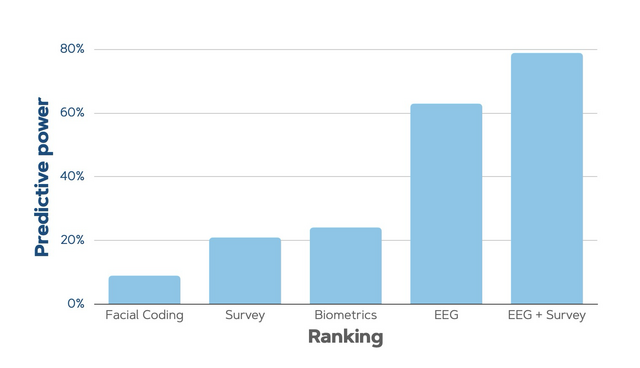
By: Nielsen Neuroscience and CBS
2. Attention and Engagement
Sales are important, but not the only outcome advertisers pursue. Many advertising campaigns also aim to stir up excitement around the brand with a striking and memorable expression. An advertisement that grabs attention makes the ad – and thus the brand – a topic of conversation.
But measuring attention is easier said than done.
How do you measure attention?
Traditionally, attention was measured indirectly. For example, by asking which ads and brands people remember after watching a commercial break. However, this completely bypasses measuring attention and its quality; you only measure one of the potential consequences of attention.
An EEG brain measurement allows direct measurement of attention processes while watching an advertisement. Unravel Research measures attention based on so-called intersubject synchronisity: this is the extent to which the brain activity of different viewers corresponds.
By measuring attention in this way, you have a performance measure that strongly correlates with several outcomes that reflect the creative impact of the expression. Namely:
- Memorability
- Talk value
- Engagement on social media (likes, sharing)
3. Message
‘Does the message get across?’ is a question many advertisers ask themselves.
This question often places the advertisement in an unjustly rational light. There are plenty of ads that do perfect work for brand and sales without communicating an explicit message. They play on emotion and intuition. And that is precisely the primary route through which advertising achieves its effectiveness.
Conversely, if an ad test shows that the intended message comes across well, it does not mean that the brand benefits from it. The brain determines whether that message is an attractive one, not the advertiser. A “As long as the message gets across” mentality can lead to a message being forced at the expense of brand and sales.
How do you measure message comprehension?
In short: message transmission is not a guarantee of success, nor does the absence of a message hinder an effective campaign.
However, it is essential that the expression can be easily processed. Our brain is busy, and many ads are processed while multitasking. Difficult commercials achieve little. With an EEG measurement, we gain insight into how much effort the brain needs to process the expression.
4. Brand Visibility
Even the most perfect commercial in the world will have zero effect if this last indispensable ingredient is missing: the brand.
Brands are nothing more than memory networks in our brain. Advertising campaigns have the potential to strengthen those memory networks, keep them fresh, and expand them with more emotion and brand associations. But the brand must be visible.
Show your brand early
The earlier the brand is activated in a commercial, the stronger the effect of the expression on the memory network in our minds. The reason lies in the workings of our brain: our brains are constantly focused on linking cues to rewards.
This learning process works exactly like Pavlov's classic experiment with his dog. When Pavlov rang a bell before his dog was fed, the dog learned to associate the bell with a reward. As a result, over time, the dog's salivary glands began to work just by hearing the bell. When Pavlov reversed this order, this learning effect disappeared. Once the reward is secured, the brain no longer needs to associate the reward with the sound.
Advertising effects are no different. Your brand is the bell, and the creative is the reward.
Brand assets do the heavy lifting
How can an advertisement activate the brand early? A simple solution is to just show the logo or incorporate it into the visuals. However, creatives rightly argue that this is quite limiting for the commercial's execution.
Fortunately, brands have what are called Distinctive Brand Assets. These are aspects of the brand that make it recognisable without having to mention the brand name or logo. Possible assets include slogans, logo shapes, colours, music, characters, etc. For example, watch the Nespresso commercial below. In the first 5 seconds, more than 10 assets can be discovered.
Neuromarketing Advertising Research Tells You Everything You Need to Know About an Advertisement's Effectiveness
In this blog, we saw that the campaign's objective determines what you need to measure to conclude whether your advertisement ‘works’. But whether the campaign focuses on sales or branding, these effects occur through unconscious and emotion-driven routes in our brain. Classic questioning provides a murky representation of a campaign's effectiveness.

Neuromarketing advertising research with Eye Tracking and EEG tells you everything you need to know about whether your campaign contributes to your objectives:
- Desire in the brain is linked to sales impact
- Engagement in the brain is linked to memory, talk value, and social liking/sharing
- Workload is linked to message processing
- Eye tracking shows whether the brand is seen
Visit our page on neuromarketing advertising research to see what you can learn by testing your expression with Eye Tracking and EEG.


