


 NL

Two prices: €3.68 and €3.69. Which one hurts the most?
Chances are you say €3.69. It is a cent more expensive, after all. Yet it is the other way around. The brain finds €3.68 more painful. One cent cheaper, and still less attractive 🤔.
That was the question we opened our lunch webinar on the perfect price with. And it is more than a fun fact, because it touches on a question we get in almost every pricing research project: what can you do in practice to choose a good price? Which numbers feel right? And what makes a good price design?
What is price pain?
Prices hurt. Literally. Look inside the brain and the response to a price resembles the response to physical pain.
And pretty much everything follows from that: the less price pain, the bigger the chance someone buys. That is the essence.
The interesting part is that this pain does not only depend on the size of the amount. The shape of the number counts too. And as a brand, that shape is entirely in your own hands.
Price fluency: the simpler the price, the less it hurts
In price psychology this is called price fluency. A price that is easy to process hurts less. That is why €3.69 beats €3.68: 3, 6, 9 is a smooth sequence your brain picks up almost automatically. With 3, 6, 8 it stumbles for a moment.
There are many more fluent prices:
- €20.40: there is a multiplication in it.
- €123.45: you might think "that is very specific". Yet this price feels better than if you add another 3 cents and it becomes completely random.
- €37.10: looks specific, but 3 and 7 make 10.
- €84.40: 8 minus 4 is 4.

And then there is the round total, like €3.70. That works almost magically, because three and seven are symbolic numbers. We come across them everywhere, in stories too, and they also do relatively well in prices. That is why a price of €97 would work well.
And what if the price is not fluent at all?
The opposite is called disfluency: a price that makes you think "this is a random string of numbers". A price like that makes people focus more on the price. They process it for longer.
And as a rule: the longer you look at a price, the smaller the chance you still buy the product.
So usually you do not want that. Unless you sell rock-bottom prices. Then you actually want people to look at your price.
Round or specific price: which mindset do you want?
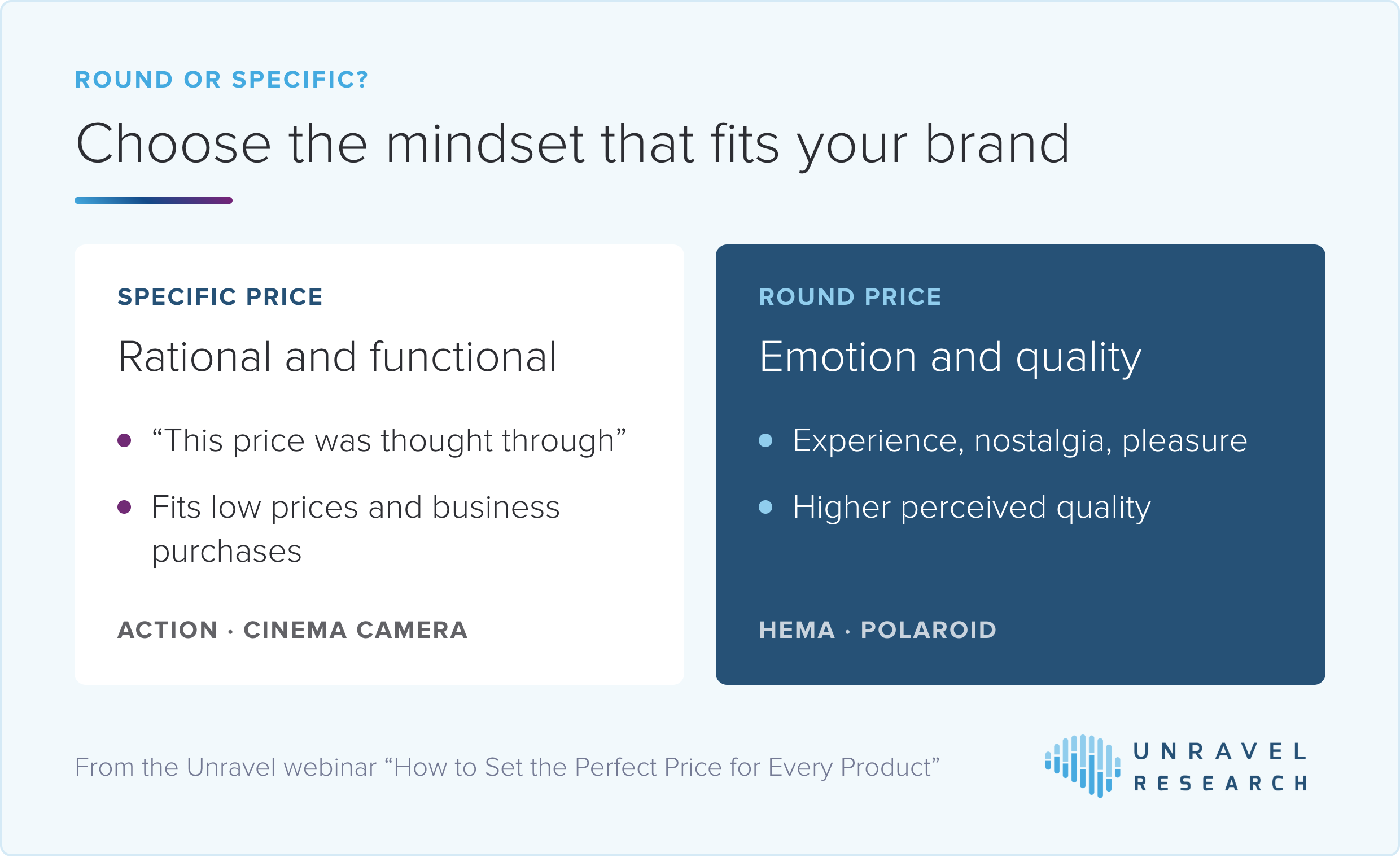
A question we often get: should my price be round or specific? Walk into an Action store and everything is ultra specific. Walk into a HEMA and you see a tendency towards round prices.
What is smart depends on the situation. Both activate a different mindset in the customer. The question is which mindset you want.
Specific prices make people more rational and functional. They also suggest that the price was carefully thought through. That is why Action does it very cleverly. You walk through that store and think: everything here is as cheap as it can possibly be, there is no room for anything less. It does not make the store more fun or more emotional, but it does not need to. Low prices literally are their proposition.
Round prices fit emotion and quality. If you sell products for more emotional reasons, because they are hedonic or because they offer an experience, round works better. HEMA does this cleverly with nostalgia, a very powerful emotion. And perceived quality thrives on a round price anyway.
Two examples make it concrete. If your company buys a cinema camera worth a few hundred thousand euros, that is mainly a functional purchase. Let that be a specific price. An instant camera, like a Polaroid, is something you buy for emotional reasons. That one should be round.
.99 or .95: why Apple and IKEA choose 95
If you do go for a psychological price, the next question follows: do you end on .99 or on .95?
Both feel good, especially when they keep you just below a higher round number. €99 or €95 feels nicer than hitting 100. But they do create a different feeling.
99 is pure discount. Fine if that is who you are. People get the feeling that you are slashing prices, but perceived quality drops straight away.
95 feels like a good deal, while perceived quality stays higher. It is associated with a fairer retailer. It is no coincidence that Apple and IKEA choose 95 and not 99.
A small choice, but it says something about who you want to be as a brand.
Where is your customer's pain threshold? You will see it in the webinar
This fragment comes from our lunch webinar How to Set the Perfect Price for Every Product, which I gave together with Tom van Bommel. Price fluency is one thing: choosing the right number. But which amount is the right one? In the rest of the webinar we show how neuro research measures where your customer's pain threshold lies, and which mistakes in classic pricing research lead to the wrong conclusions. Because asking people what they would pay for it does not give you that answer.
Curious? Watch the full webinar for free, including the slides and the key insights as a download.


